

Every few months, someone calls us genuinely stressed about an old piano, organ, or drum kit that’s been sitting untouched for years, and they just don’t know what to do with it. It’s usually not about the money. It’s about the fact that these things are heavy, awkward, full of memories, and nobody in the household wants to be the one who finally deals with it.
Call or WhatsApp: +65 8698 0497
We’ve cleared instruments out of HDB flats, condos, landed homes, music schools, and studios across Singapore, and the short version is this: instruments are some of the hardest household items to move safely, and most people underestimate just how much can go wrong if it’s done without the right equipment and experience.
Here’s what we’ve picked up doing this job, and what it actually takes to get a piano, organ, drum set, or old guitar out of your home without damaging anything — including your back.
Why Instruments Are Harder to Move Than They Look
A sofa is heavy, but it’s also somewhat forgiving — bump it against a wall and you’ll scuff the paint. Instruments are a different problem entirely.
- Upright pianos typically weigh between 180kg and 300kg, concentrated in an awkward, boxy shape that doesn’t balance well on a hand truck
- Electric organs are bulky, oddly weighted, and often harder to grip than their size suggests
- Drum kits look manageable until you remember they’re actually five or six separate heavy pieces plus a tangle of metal stands
- Amplifiers, keyboards, and synths are lighter, but they’re built around circuit boards that don’t survive a drop
Add in Singapore’s narrow HDB corridors, tight lift sizes, and staircases in landed homes, and you’ve got a job that genuinely needs trained hands — not because we’re trying to upsell you, but because we’ve seen what happens when it’s attempted without them: scraped lift walls, dented staircases, and in a few cases, someone hurting their back trying to carry a piano alone.
That’s the real reason professional removal gets recommended for this category more than almost anything else we handle.
Upright and Digital Piano Disposal
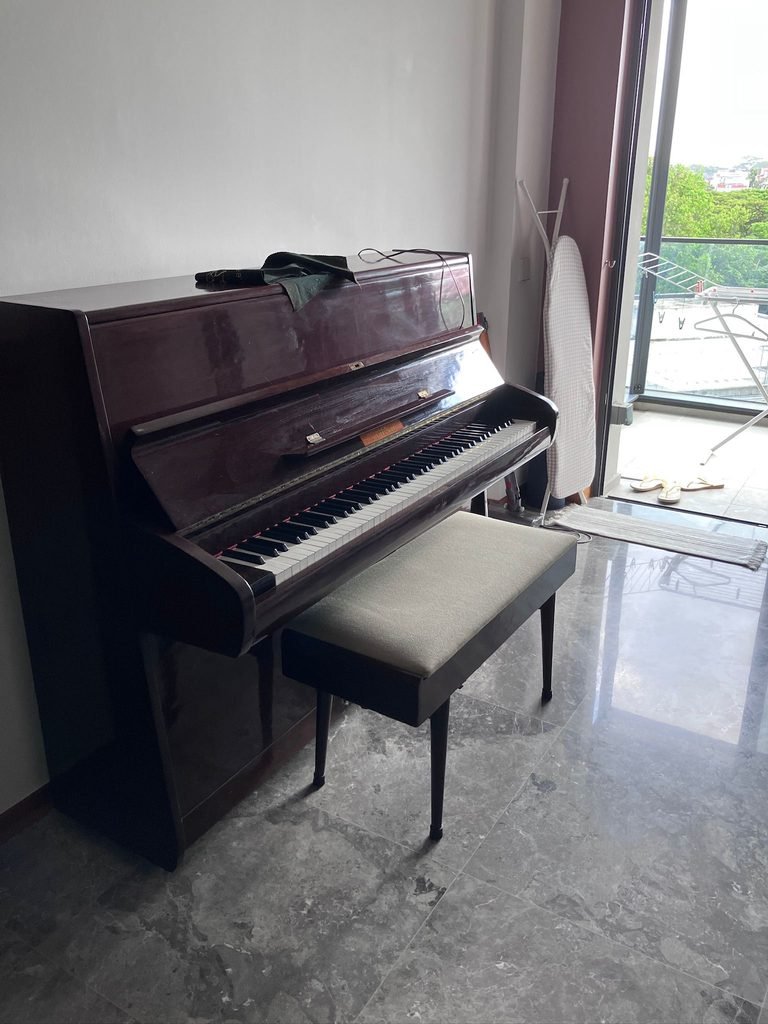
This is the request we get most often, and it almost always follows the same story: a piano bought years ago for a child’s music lessons, barely touched since, now just taking up a corner of the living room.
We handle both ends of the piano spectrum:
- Upright pianos, including older models that are heavier and more awkward than people remember
- Digital pianos, which are lighter but still bulky enough to need careful handling
- Damaged or water-spoilt pianos that are no longer worth repairing
Before we quote anything, we actually look at your access — whether you’re in an HDB flat, a condo, or a landed property, the lift size, the staircase width, and whether there’s a loading bay changes how the job gets planned. We’d rather ask a few extra questions upfront than show up and discover the piano doesn’t fit through the door the way everyone assumed.
If you’re weighing up your options before committing to a paid pickup — including whether donation or town council collection might work for your piano first — our full guide to piano disposal in Singapore breaks down all five routes, including which ones are free.
Organ Disposal in Singapore
If your household has a large electric organ sitting untouched since the 80s or 90s, you’re not alone — we still get called out for these more often than people expect, especially the bulkier Yamaha-style and Electone-style models.
Organs are a specific kind of difficult:
- They’re heavier than their size suggests, often more awkward to carry than an upright piano
- They’re packed with internal wiring and built-in speakers, which makes them fragile in ways that aren’t obvious from the outside
- They can’t really be taken apart without damaging the casing, so the whole unit has to move as one piece
We handle organ removal the same careful way we handle pianos — assessing access first, then moving it out intact rather than risking damage by trying to dismantle something that wasn’t built to come apart.
Drum Set Disposal
Drum kits are deceptive. Set up, they don’t look like much — but once you start loading them into a lift, you realise you’re dealing with a bass drum, snare, floor tom, rack toms, cymbals, and a pile of metal stands and hardware, all of which need to go somewhere.
Kits that have been sitting in storage for years often come with a layer of dust and some rusted hardware too, which makes handling them a bit messier than people expect. Whether it’s a single family drum kit in a spare room or a full set of kits from a music studio or school needing clearance, we handle drum set disposal as a complete job — not piece by piece.
For schools, studios, and music centres clearing multiple instruments at once, we also arrange bulk collection, which usually works out more efficient than booking separate pickups for each item.
Guitars, Keyboards, and Other Electronic Instruments
Smaller instruments are obviously easier to carry out than a piano, but they still need to be disposed of properly rather than tossed out with regular rubbish.
We remove:
- Acoustic and electric guitars
- Broken or outdated keyboards
- Synthesizers
- Amplifiers
- PA systems and audio mixers
A lot of these — keyboards, amps, synths, mixers — technically fall under e-waste because of the circuit boards and electronic components inside them. That means they need to go through proper e-waste handling rather than general rubbish collection. If you’re also clearing out other electronics at the same time, our guide to where to dispose of electronics in Singapore covers how e-waste disposal actually works here.
What Happens to the Instrument After We Take It
We’re not going to pretend every single component gets perfectly recycled — some materials genuinely can’t be separated economically. But where it’s feasible, we do separate out the wood, metal, and electronic parts so they can be routed through proper recycling rather than ending up as dead weight in a landfill.
It’s also worth saying plainly: dumping a bulky instrument in a void deck, corridor, or common area isn’t just inconsiderate to your neighbours — it can result in fines or enforcement action from your town council or management. Booking a proper collection avoids that entirely, and honestly, it’s usually less hassle than people expect once it’s arranged.
Getting a Quote
If you’ve got a piano, organ, drum kit, or a mix of instruments and other household junk that needs to go, the easiest next step is to tell us what you have and where it’s located. We’ll factor in your unit type and access before giving you a number, so there are no surprise charges on the day.
If you’re clearing a whole room or property rather than just the instrument, it’s often more efficient to bundle everything into one job — our bulky item disposal guide for Singapore covers what typically qualifies for a combined pickup.
Frequently Asked Questions
How much does piano or organ disposal cost in Singapore?
It depends on the instrument’s size, your unit’s access (stairs, lift size, loading bay), and whether you need other items cleared at the same time. We give straight quotes after a quick look at your situation — no hidden charges added later.
Can I just leave my old piano or drum kit at the void deck?
No. Leaving bulky items in common areas can lead to fines or enforcement action. It also tends to sit there for a long time, which isn’t fair on your neighbours. Booking proper collection is the safer route.
Do you take instruments for free?
Generally no — professional removal involves manpower, equipment, and transport, so there’s a fee involved. If your piano is still in good working condition, donation is sometimes an option worth exploring first; our piano disposal guide covers that route in detail.
Can you collect from schools or music studios with multiple instruments?
Yes, we regularly handle bulk clearance for schools, studios, and music centres. Let us know roughly how many instruments and what types when you reach out, and we’ll scope it accordingly.
What happens to electronic instruments like keyboards and amps?
These are treated as e-waste due to the circuit boards inside and are routed through proper e-waste disposal rather than general rubbish.
📱 Call or WhatsApp us for a quote: +65 8698 0497 🌐 amkavinmovers.com
This article is based on our general experience handling instrument disposal across Singapore and is intended to help you understand your options. Specific regulations can vary, so check with your town council or management corporation if you need anything confirmed for your exact situation.